 Notus Systems
Introducing the N-1
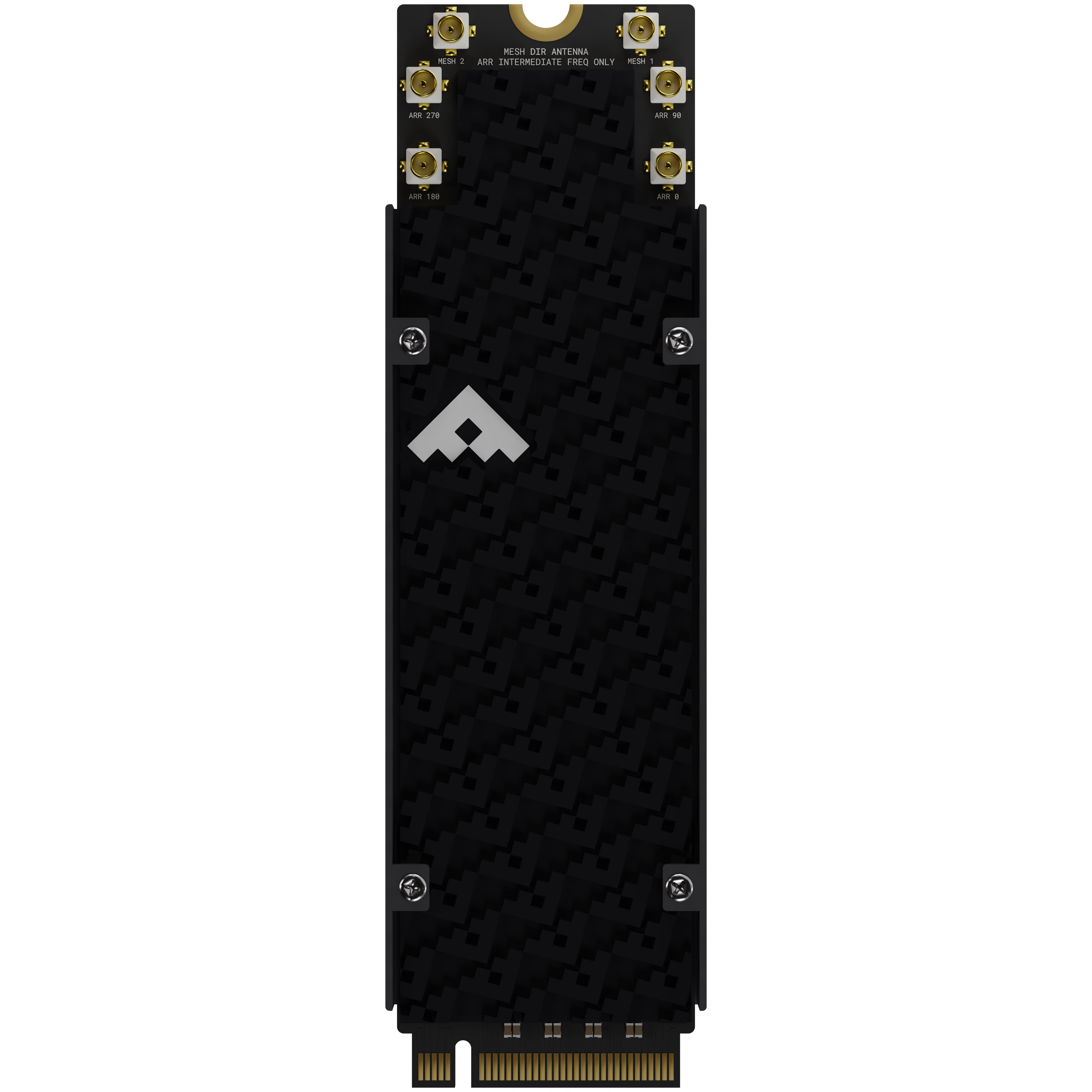
The world's first phased array swarming system
American spectrum dominance at scale
The United States intends to scale drone production to millions of units per year, but has no way to coordinate them under hostile electronic warfare at scale.
After a year in stealth, we built the answer.
The Notus N-1 is a software-defined phased array mesh radio that gives every node in the swarm interference-resistant, self-healing connectivity and precise positioning — no infrastructure required.
Contact usPhase 1
MESH RADAR
AI assisted position solving
Specially constructed radar pulses feed a first-of-its-kind inference engine. Swarm geometry is reconstructed from signals up to 100,000× weaker than hostile interference — without GPS or base stations.
Phase 2
BEAMFORMING
Directional drone-to-drone links
Using the swarm geometry provided by the mesh radar system, each drone steers its own phased array to form directional links to neighbors. Instead of wasting power transmitting in all directions, focused beams deliver interference-resistant, peer-to-peer, high-gain connectivity. No central relay, no omnidirectional waste, no channel contention.
Atmospheric blanket
Not all frequencies are created equal
All drone communication networks operate near the microwave band. But not all frequencies are created equal. At 60 GHz, atmospheric oxygen creates a natural blanket that absorbs undirected RF energy at 15 dB per kilometer.
Brute-force jamming power dissipates before it arrives. Directed swarm links pass through unaffected.
Hover over the spectrum to explore.
The best of both worlds
While the physics of 60 GHz prevents long range jamming, the geometry of drone swarms allows optimized relay spacing. Atmospheric attenuation inverts the rules of electronic warfare. Transceiver agility, not raw power, wins.
Frequency selective spacing
Notus swarms automatically optimize operating frequency to balance link distance and interference rejection. When no interference is present, the swarm negotiates a lower frequency with longer range. When interference is present, the swarm increases its frequency and contracts to counteract even strategic jamming.
Low probability of detection
Conventional FPV systems broadcast video to the entire battlefield. The Notus N-1 transmits a narrow beam of energy requiring precise alignment to detect. By the time adversaries can detect the drone, it's too late.
Scale
From 100 to 10,000
Every autonomous swarm to date has hit the same ceiling: simultaneous localization requires each node to communicate with every other, creating O(N²) channel activity that saturates available spectrum. The largest autonomous swarms in history have stalled around 100 units.
Notus' groundbreaking mesh radar algorithm inverses this problem. Drones resolve swarm geometry in real time with no limit on swarm size. Instead of competing for air time, nodes cooperate in a fully decentralized protocol that only becomes more accurate as the number of nodes increases.
Interference resistance
* 2 km link, 5 km jammer standoff, 20 dB beamforming, 15 dB/km atmospheric attenuation (ITU-R P.676)
One system. GPS-free localization. Strategically uncontestable communication.